Search for the world's largest Funko Pop! collection and the numbers quickly become difficult to compare. A record entry gives one count. A later interview gives another. A spectacular room tour suggests a third. The first useful question is not simply which number is biggest: it is what each source actually establishes.
The difficulty is that a verified record, a collector's reported total and a spectacular display are different kinds of evidence. Publicly documented does not automatically mean independently counted, and yesterday's record does not establish today's largest collection.
There are useful historical benchmarks to explore. The trick is knowing what they prove - and where the evidence stops.
Follow the record trail, not just the biggest headline
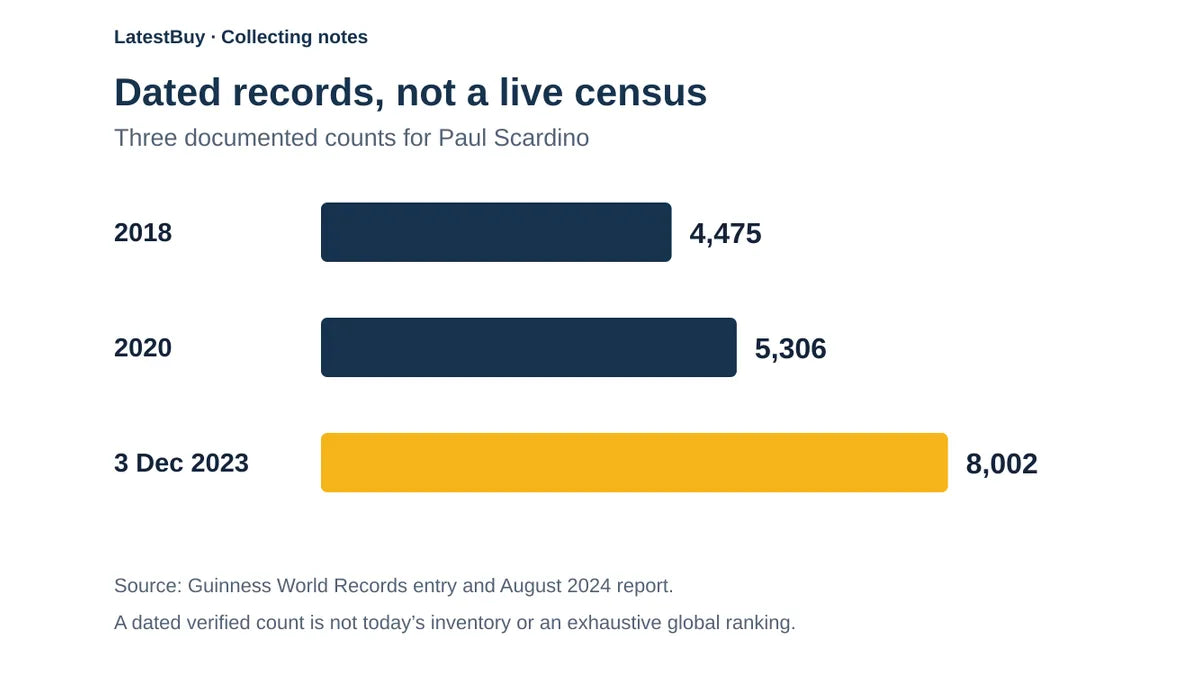
The Guinness World Records entry lists Paul Scardino's collection of 8,002 Funko Pop! figurines, achieved in Stephens City, Virginia, on 3 December 2023. That is a published, dated record - not a fresh count of everything he owns today.
Guinness's August 2024 report also traces the earlier benchmarks: Scardino's 5,306-item collection in 2020 and David Mebane's subsequently recognised 7,095 figurines, before Scardino reclaimed the record with 8,002.
Those figures belong to the history of documented collecting records. They should not be presented as a live ranking or assumed to be either collector's present-day total.
The distinction matters because a record announcement and a later interview may describe the same collection at different stages. An owner might continue buying after a count, sell part of the collection, change its focus or reorganise what they include. A later personal total does not automatically inherit the verification attached to an earlier record.
These historical examples establish something substantial: collections numbering in the thousands have appeared in recognised record reporting. They do not establish that every larger private collection has been assessed, that the collectors still own precisely those quantities, or that no subsequent record exists.
That is why a responsible account is better described as a record trail than a universal leaderboard. To establish a current holder, the record organisation's current entry needs to be checked for its holder, achievement date, total and category - not merely quoted through an older article.
The impressive number deserves attention. Its date deserves to travel with it.
Use this quick buying checklist before choosing the next option:
- Match the product or category to the occasion, recipient or use case.
- Compare size, care needs, setup effort and everyday practicality.
- Decide which trade-offs matter most before browsing similar alternatives.
- Check whether a more specific category or guide gives a better next step.
- Avoid choosing only by novelty if durability, fit or repeat use matters.
- Pick the option that makes the next decision easier, not just the quickest click.
Make sure every collection is counting the same thing
Before comparing two totals, establish the unit being counted. "Funko collection", "Pop! collection" and "vinyl figure collection" are not interchangeable descriptions.
Funko is a brand; Pop! is a product line. A wider collection might also contain pins, keyrings, other figure formats and accessories. Those items can belong together on a fan's shelf without belonging in the same counting category.
Even a single retail package can complicate matters. A retail package containing a Pop! figure and a pin combines different collectable formats. Its contents should not automatically be described as two Pop! figurines.
For any large collection claim, look for clarity about:
- Physical items versus distinct releases: several copies of one release increase an item total without adding the same amount of variety.
- Figures versus packages: a multi-figure pack creates a different counting question from a single boxed figure.
- Variants versus duplicates: different finishes, poses or editions need a consistent identification method.
- Owned pieces versus catalogue entries: a wishlist, preorder or database listing is not necessarily an item physically held.
- Personal ownership versus stock: a retailer's inventory or public exhibition is not directly comparable with one person's private collection.
These are questions to ask of the evidence, not a substitute for any particular record organisation's rules.
Imagine one collector reporting every physical figure and another reporting only distinct releases. The larger total might represent more objects, while the smaller total represents greater variety. Neither description is inherently wrong; they answer different questions.
Without that distinction, a neat-looking ranking can compare entirely different things.
Recognise where public documentation runs out

A room tour can show an extraordinary display. It cannot, by itself, establish an exact collection total.
Boxes may be stored behind the visible rows. Some items might appear in more than one shot. Other pieces may be in storage, awaiting sale or temporarily borrowed for a display. None of that makes the collector's account dishonest. It simply limits what a viewer can independently conclude.
Different sources also do different jobs. A collector's interview is valuable evidence of what the owner says they hold. A dated inventory gives more detail about the stated contents. Independent verification can provide stronger support for the particular count assessed. Photographs help show scale and condition, but rarely resolve every counting question.
Repetition is another trap. Five websites repeating one interview are not five independent counts. The useful task is to trace the number back to its original source and determine whether that source describes an assessment, an estimate or an owner's statement.
There is also a visibility limit: private collections do not become measurable merely because they exist. An owner may never publish an inventory or seek recognition. Consequently, "largest publicly documented collection" is a narrower claim than "largest collection anywhere".
Size should also remain separate from value. A collection's quantity does not establish its resale worth, and an estimated database value is not the same thing as completed sales. Condition, authenticity and the exact releases involved require their own evidence.
The defensible conclusion is specific: a source documents a stated collection, under a particular definition, at a particular time. Anything beyond that needs further support.
Borrow the organisation, not the record-breaking target

For most fans, the practical lesson is not to catch a record holder. It is to make a collection easier to enjoy before its contents become difficult to track.
Start with a simple inventory. Record the character, product line, identifying number where applicable, distinguishing edition details, condition and storage location. Keep owned items separate from wanted items. For anything with visually similar versions, include a clear photograph rather than relying on a shortened name.
That modest habit helps with both duplicate avoidance and gift buying. A friend can work from an accurate wishlist instead of trying to decode a shelf photograph taken six months ago.
Display planning deserves equal attention. Measure the usable width, height and depth of the shelf, then measure the actual boxed or unboxed item-including any protector or stand. Oversized releases and elaborate bases should not inherit the space allowance of a smaller figure simply because both say Pop! on the listing.
Boxed and open displays involve different trade-offs. Boxed collecting keeps the packaging visible but makes its footprint part of the display. Open display lets you arrange characters more freely, while requiring somewhere suitable for retained packaging and accessories.
Group pieces by a theme that makes sense to you: a favourite film, a character, a shared childhood memory or simply a colour-balanced arrangement. Risers can improve visibility, provided the shelf has enough depth and the arrangement remains stable. Lighting should reveal the display without adding avoidable heat or glare.
Keep figures and packaging away from direct sunlight and damp conditions, and follow relevant care instructions when removing dust. Leave access for cleaning rather than packing every gap.
The shelf, inconveniently, does not expand with your enthusiasm. A collection that you can see, maintain and explain offers more everyday enjoyment than a bigger total you can barely navigate.
Use the records as context, not a buying target

A record-sized collection can make an ordinary addition seem inadequate. It does not follow that the next piece needs to be rarer, more expensive or dramatically larger. A public item count is not a recommendation about what any other collector should buy.
For an established collector, an exact wishlist entry or listing is more useful than an impressive total. Confirm the character, version and format, and ask whether packaging condition matters. Two figures can represent the same character while being very different additions to an existing display. If the person has deliberately paused new purchases, respect that decision rather than treating empty shelf space as a problem to solve.
For a newer fan, start with a recognisable interest and a manageable display plan. Keep wanted pieces separate from owned pieces, check the actual item dimensions and avoid buying merely because someone predicts a future increase in value. A product listing establishes what is offered; it does not establish future scarcity or investment performance.
Browse LatestBuy's Funko collection with a favourite character, a clear format preference and a realistic space allowance in mind. Compare individual listing details before deciding. A well-chosen addition needs a reason to belong on that particular shelf, not a role in somebody else's record chase.
The largest publicly documented collections remain a fascinating subject. Their totals need dates, definitions and traceable primary evidence. Keep the published record distinct from a present-day inventory, and leave room for what the available evidence cannot establish.
For the next browse step, compare the fit against LatestBuy gift guide.